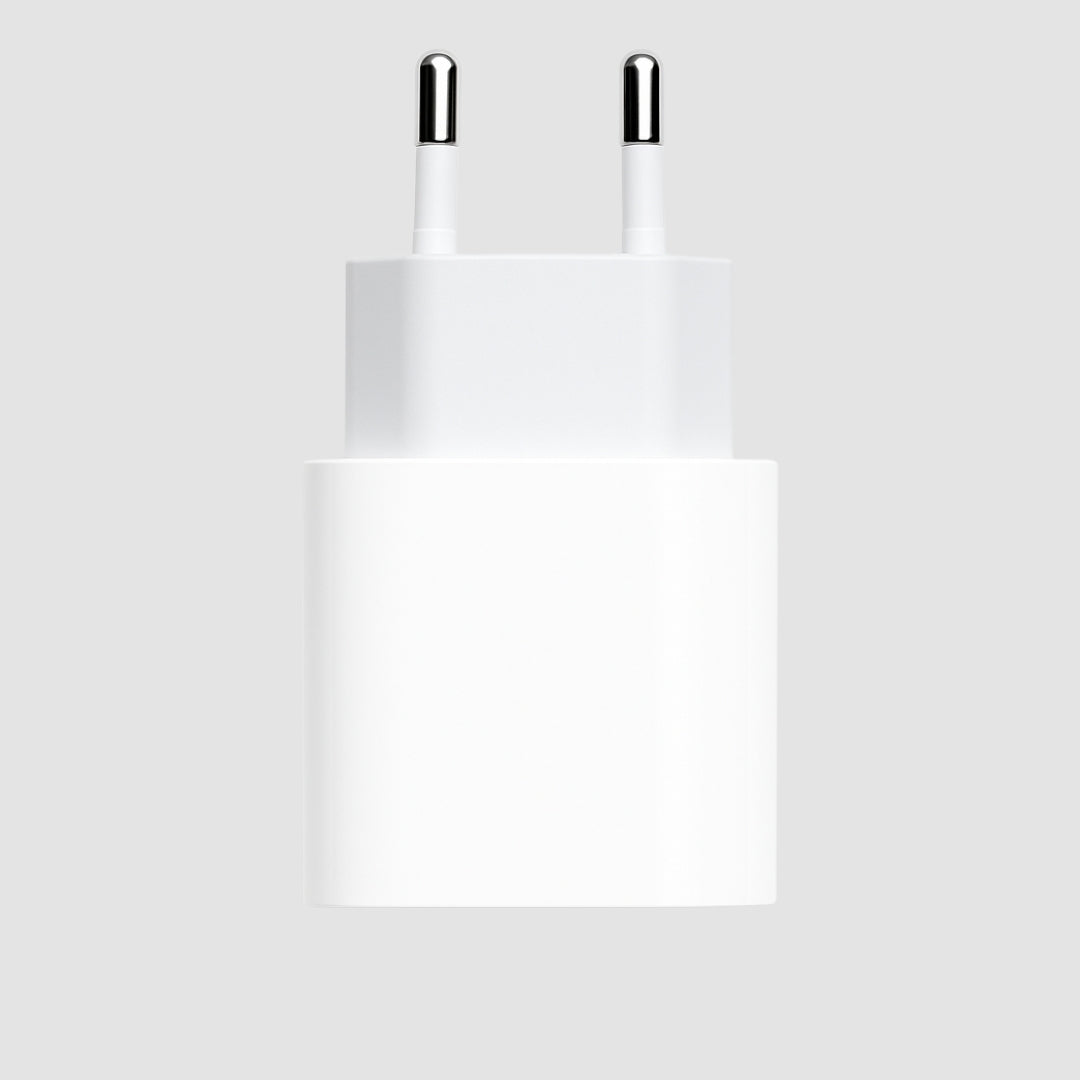


The scenario is familiar: you're at 15%, you have 20 minutes before you leave, and the charger you have in the drawer takes you... for a ride. That's exactly where the USB C 20W wall charger comes in - not as a "gadget," but as the essential piece that makes charging genuinely useful in everyday life.
What the USB C 20W wall charger means in practice
20W strikes a balance that suits many people. It's enough power for fast charging iPhones (ideally with USB-C to Lightning) and many Android phones that support USB Power Delivery (PD). It's not "the most powerful" on the market, but for everyday use, it's one of the safest choices: fast, small, usually affordable, and keeps things simple.The "USB-C" here refers to the port on the charger itself. This is important because the USB-C port is what connects to the most modern cables and fast charging protocols. Simply put, a USB-C 20W charger is more likely to "communicate correctly" with your device compared to an old USB-A one.
Which phones is it best suited for?
If you have an iPhone, the 20W category is almost the sweet spot. Most recent models charge quickly with 20W, and you don't need anything more powerful to see a substantial difference in daily use. If you have an iPhone with Lightning, you'll need a USB-C to Lightning cable. If you have an iPhone with USB-C, then you'll need a USB-C to USB-C cable.For Android, things are a little more "it depends." Many Samsung, Xiaomi, Motorola, Pixel, etc., charge comfortably with PD at 20W, especially for office use, bedside charging, or power top-ups during the day. Some models, however, have their own protocols (e.g., "Super Fast Charging" on specific devices) that might perform better with 25W or 45W. This doesn't mean the 20W won't work - it just means you might not see the "max" advertised by the phone.
If you want a simple logic: for iPhone, it's almost always "yes." For Android, it's "yes" for safe and fast everyday charging, and "maybe" if you're chasing the absolute 0-100 in the shortest possible time.
PD is more important than the number
If you take one thing away, take this: USB Power Delivery (PD) is key. It's not enough for it to say 20W. You want a charger that supports PD so it can properly "negotiate" power with the device. This allows for smarter charging, avoids strange behaviors (e.g., fluctuating speed), and usually offers better compatibility with more devices.There's also the PPS (Programmable Power Supply) parameter, which often appears in newer chargers, primarily for Android. It's not essential for everyone, but if your phone takes advantage of it, it helps to charge more efficiently and with better temperature control. If you don't want to get into details, choose PD and you're in a very good place.
The cable can make a difference
Many people get a 20W charger and then use an old, worn-out cable. The result? Slow charging, disconnections, overheating, or just frustration.For iPhone with Lightning, the right combo is a USB-C 20W charger + a good quality USB-C to Lightning cable. For Android/USB-C, you need a USB-C to USB-C cable that supports charging and is in good condition. If the cable is too thin, too old, or a "no name" brand with poor construction, it can limit performance even if the charger is perfect.
And something practical: if you often charge in the car, at the office, and at home, it's convenient to have 2-3 identical cables. This reduces wear and tear from constant carrying and ensures you always have a "reliable" one.
20W vs 25W/30W: when is it worth upgrading?
20W is perfect for many, but not for everyone. If you have an Android that supports 25W or more and want consistently faster charging times, then stepping up makes sense. Also, if you're charging a small tablet or frequently use a hotspot and heavy apps, a more powerful adapter can better maintain the pace.On the other hand, if your phone "cuts" power anyway when it gets hot or approaches 80-90%, you won't always see a huge difference. Charging isn't constantly turbo. Devices protect their batteries, and this means maximum speed mostly lasts for the initial part.
If you're looking for value for money without second thoughts, the USB C 20W wall charger is the safe purchase. If you're chasing performance down to the minute, look at 25W/30W, especially for specific Androids.
Safety: what to look for so you don't regret it
A charger involves electricity. So, no playing around here. You want protections and proper temperature behavior, especially if you charge next to your bed or leave your phone plugged in while doing other things.It's a good sign when the charger mentions protections like overvoltage, overcharging, overheating, and short-circuiting. Also, manufacturing quality is evident: a stable plug, proper fit in the outlet, a body that doesn't "creak," and of course, not excessive heat to the touch.
Another "small" thing that helps: if you're using power strips, choose a charger that fits properly and isn't squeezed by adjacent outlets. When something is constantly bent, it breaks more easily.
Practical scenarios for choosing correctly
If you want a charger that will serve you well everywhere, the 20W USB-C is the choice for home and office. It's also convenient for travel, as it's small and compatible with many devices. If you have a second device like headphones, a smartwatch, or a power bank, you'll still use it; each device will simply draw what it needs.If you're thinking "one charger for everything," then the decision is mainly: do I want one port (simpler, more compact) or multiple ports (to charge 2 devices at once)? This article focuses on 20W, which usually means a single port. If you want dual charging, you often move up to a different category.
Small tips that make charging faster
If you think your charger isn't performing, before blaming it, try something simple. Remove the case if it's very thick and traps heat, especially in summer. Place the phone in a well-ventilated area, not on a pillow or in direct sunlight. And if you need a "boost" before you leave, put it in airplane mode or turn off the hotspot - often you gain minutes without changing anything else.Also, if you're charging while playing a game or on a video call, it's normal not to see a huge increase. In that case, it's not the charger's fault; consumption is simply running in parallel.